
In our actual manufacturing, many engineering selection errors come from cognitive deviations of multi-axis equipment. Do you think higher axis means higher precision? 4-axis can replace 5-axis for all multi-sided parts? 5-axis improves processing efficiency for all parts?
What’s the truth? I don’t wanna ask now, I believe you will get answer after you read below words.This article systematically compares the working principles, core advantages, applicable scenarios, and cost differences of 3-axis, 4-axis, and 5-axis CNC machining. We will focus on solving the core problem: what scenarios truly require 5-axis CNC machining, and when 3/4-axis is more cost-effective?
Blog Outline
1. Basic Working Principle & Core Definition of 3/4/5-Axis CNC
The “axis” of a CNC machine refers to the relative motion direction between the cutting tool and the workpiece. The number of axes directly determines the machine’s spatial processing capability, clamping flexibility, and complex part adaptability.
1.1 3-Axis CNC: The Foundation of Standard Machining
3-axis CNC machines operate based on three linear axes: X (left-right), Y (front-back), Z (up-down). The tool always maintains a vertical downward cutting posture, with no rotary motion of the work piece or tool during processing.
Core Features: Simple structure, low programming difficulty, stable operation, and extremely high versatility. It is the most widely used mainstream equipment in precision machining.
Processing Limitations: Only horizontal planes, straight grooves, and 2D contours can be completed in a single setup. Machining multi-sided or angled features requires manual repeated clamping and positioning, which introduces cumulative positioning errors.
1.2 4-Axis CNC: Efficient Upgrade for Multi-Sided Parts
4-axis CNC adds one independent rotary axis (usually A-axis rotating around X-axis or C-axis rotating around Z-axis) on the basis of 3 linear axes. The workpiece can realize indexing or continuous rotary cutting with the worktable.
Core Features: Realizes one-clamp multi-sided machining, eliminates repeated clamping errors of 3-axis processing, greatly improves the consistency of multi-hole and multi-position features, and has lower equipment and programming costs than 5-axis.
Processing Limitations: Only single-direction rotation is supported. It cannot process complex spatial curved surfaces, deep cavity inclined holes, and overlapping angle features, and still has obvious dead angles for irregular parts.
1.3 5-Axis CNC: Ultimate Solution for Complex Precision Parts
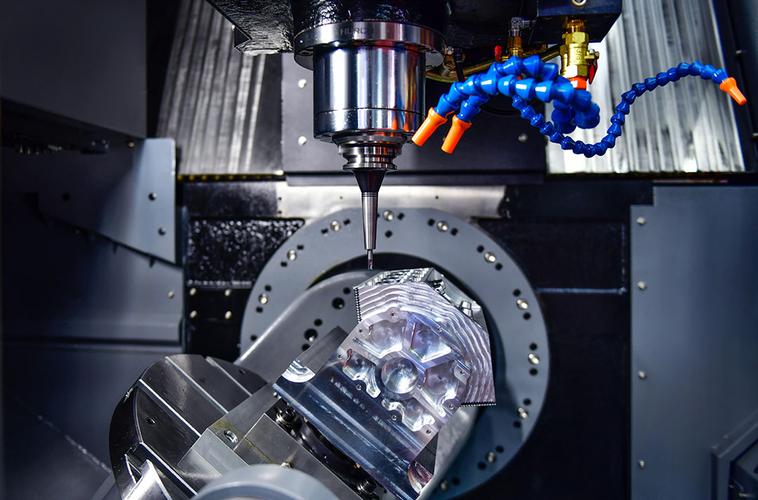
5-axis CNC retains X/Y/Z three linear axes, plus two mutually independent rotary axes (A+B or A/C). The tool can adjust the angle freely in three-dimensional space, and the workpiece can achieve arbitrary spatial posture positioning.
Core Features: True one-time clamping full-stroke machining, no processing dead angles, capable of adapting to complex free-form surfaces and arbitrary angle features. It optimizes tool cutting posture, reduces tool wear, and improves surface finish.
Processing Limitations: High equipment investment, high CAM programming difficulty, high requirements for operator experience and machine maintenance, and significantly higher unit processing costs than 3/4-axis.
2. Comprehensive Comparison: 3-Axis vs 4-Axis vs 5-Axis CNC
To help engineers quickly complete model selection, we sort out the core dimensional differences of the three types of CNC machines from the perspective of actual production, including efficiency, precision, cost, and applicable complexity.
Comparison Dimension | 3-Axis CNC | 4-Axis CNC | 5-Axis CNC |
Machining Capability | 2D contours, planes, regular hole systems | Multi-sided features, circumferential grooves, radial holes | Complex curved surfaces, deep cavity inclined holes, spatial composite angles |
Clamping Times | Multiple times for multi-sided parts | 1 time for conventional multi-sided parts | 1 time for almost all complex parts |
Positioning Error | High (cumulative clamping error) | Medium (greatly reduced error) | Ultra-low (no repeated positioning error) |
Processing Efficiency | Low for complex parts | Medium and high | Highest (shortest auxiliary time) |
Manufacturing Cost | $ | $$ | $$$ |
Programming Difficulty | Low, universal templates | Medium, simple rotary linkage | High, requires professional CAM programming |
3. Scenario Selection Guide: When to Use 3/4/5-Axis CNC
Axis number selection is essentially a matching between processing capability and part demand. The following is the most practical engineering selection standard, avoiding over-processing and insufficient processing.
3.1 Choose 3-Axis CNC: Most Cost-Effective
3-axis CNC is still the optimal choice for 80% of conventional basic mechanical parts, with no need for higher-axis equipment.
Applicable Scenarios:
Flat parts, rectangular structural parts, and simple cavity molds with only planar features
Vertical hole systems, straight grooves, and regular 2D outline profiling parts
Mass-produced standard parts with low requirements for multi-position tolerance consistency
Engineering Advantage: Save money, troubleless, low equipment depreciation, low processing threshold, sufficient personnel reserves, and stable delivery quality for conventional parts.
3.2 Choose 4-Axis CNC: Best for Multi-Sided & Cylindrical Parts
4-axis is the cost-effective intermediate solution between 3-axis and 5-axis, perfectly solving the pain points of low efficiency and poor precision of 3-axis multi-sided processing.
Applicable Scenarios:
- Cylindrical, circular tube, and rotary parts requiring circumferential uniform hole and groove processing
- Box parts with 2–3 processing surfaces and strict position tolerance between surfaces (≤0.05mm)
- Parts needing indexing processing without complex spatial angle features
Engineering Advantage: Avoids the high cost of 5-axis equipment, realizes one-clamp multi-sided forming, and balances efficiency and cost.
3.3 Choose 5-Axis CNC: Only for These Irreplaceable Scenarios
5-axis CNC is not a universal upgrade equipment, but a special equipment for complex precision parts. Only when 5-axis is irreplaceable, and 3/4-axis cannot complete processing at all or fail or risk to meet the standard.
Core Scenarios Require 5-Axis CNC:
Complex free-form surface parts: Aerospace blades, turbine impellers, automotive interior mold curved surfaces, and medical prosthetic parts. Such parts have irregular spatial curves, and 3/4-axis cannot complete continuous profiling cutting.
Deep cavity & oblique angle closed structural parts: Deep cavity molds with internal inclined holes, overlapping groove positions, and spatial composite angles. 3/4-axis processing has serious tool interference and dead angles, unable to form at one time.
Ultra-high tolerance consistency parts: Precision aerospace and semiconductor parts with multi-dimensional spatial position tolerance ≤0.02mm. 3/4-axis repeated clamping will inevitably produce cumulative errors, only 5-axis one-time clamping can ensure full-size consistency.
Short-cycle complex customized parts: Multi-feature complex prototypes and customized parts. 5-axis eliminates repeated clamping and tool setting steps, greatly shortens the proofing cycle and avoids size deviation caused by multiple adjustments.
Key Engineering Judgment: If your part has spatial non-planar features, tool interference risks, and multi-angle ultra-precision tolerance requirements, 5-axis CNC is the only viable solution; otherwise, 3/4-axis is more cost-effective.
4. Summary
3-axis, 4-axis, and 5-axis CNC machines have their own fixed application scenarios and advantages, with no absolute distinction between good and bad. Reasonable axis selection is the core of optimizing processing efficiency and controlling manufacturing costs.
Choose 3-axis CNC for standard planar and regular parts to maximize cost performance;
Choose 4-axis CNC for multi-sided and rotary parts to balance efficiency and precision;
Choose 5-axis CNC only for complex curved surfaces, spatial composite angles, and ultra-precision parts with high consistency requirements.
For manufacturing engineers, abandoning the “axis number supremacy” thinking and matching equipment with part process requirements is the key to improving production efficiency and product qualification rate. we should notice a higher axis is not mean better decision. It is a strategic should remember, we should balance of part geometry, tolerance requirements, production efficiency, and manufacturing cost.
We, Shenzhen RPD Industrial Co.,Ltd have 100+ advanced 3/4/5 axis and mill turn CNC machining center with tight tolerance , contact us today!
Tell Us About Your Project Today!
Turn your concept into production today, Validate your design with real parts!
5. FAQs About 3/4/5-Axis CNC Machining
1. Is 5-axis CNC necessary for mold processing?
Not necessarily. Conventional flat molds, straight-groove injection molds, and simple cavity molds are completely suitable for 3-axis processing. Only 3D curved surface molds, deep cavity inclined top molds, and complex automotive covering molds require 5-axis machining to ensure surface finish and dimensional accuracy.
2. What is the biggest difference between 4-axis and 5-axis CNC in actual processing?
The core difference is spatial angle adjustment capability. 4-axis only has one rotary axis, which can only realize single-plane indexing rotation; 5-axis has two rotary axes, which can adjust the tool posture arbitrarily in 3D space, avoid tool interference, and process all-angle complex features without dead angles.
3. Can 5-axis CNC reduce production costs?
It depends on the part type. For simple parts, 5-axis has higher equipment and programming costs, increasing overall expenses. For complex multi-feature parts, 5-axis reduces clamping times, eliminates error rework, shortens processing cycles, and the comprehensive manufacturing cost is lower than 3/4-axis.
4. Do 5-axis parts need higher programming skills?
Yes. 5-axis machining requires professional CAM software for multi-axis linkage programming, tool path optimization, and interference detection, which has a higher technical threshold than conventional 3/4-axis programming. It needs programmers to master spatial geometric analysis and multi-axis tool path logic.
5. For small-batch prototype processing, is 5-axis worth it?
Worth it for complex prototypes. Small-batch complex prototypes require frequent clamping and adjustment by 3/4-axis, with long cycle and high rework rate. 5-axis one-time clamping forming can quickly complete proofing, shorten the delivery cycle, and reduce trial-production costs caused by size errors.
6. What industries must rely on 5-axis CNC machining?
Aerospace (turbine blades, structural frame parts), medical devices (implant parts, precision instruments), new energy vehicles (complex battery molds, motor impellers), robotic, high end precision automotive parts/ mold industries. These fields have irreplaceable requirements for complex curved surfaces and ultra-high spatial tolerance.
Share this article