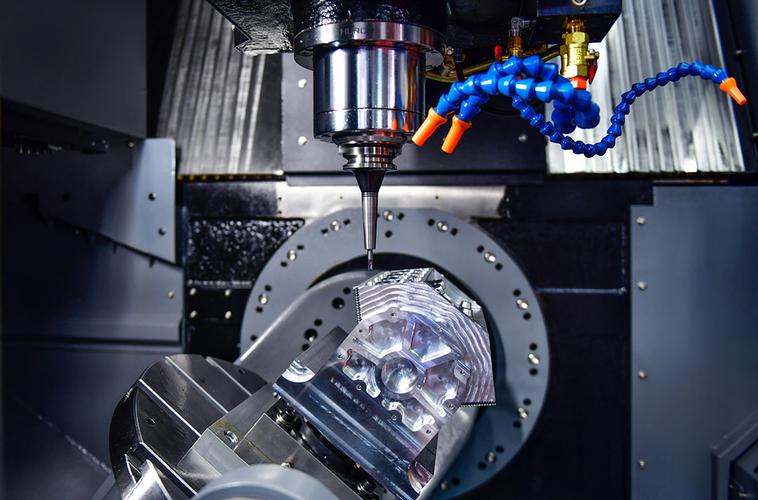
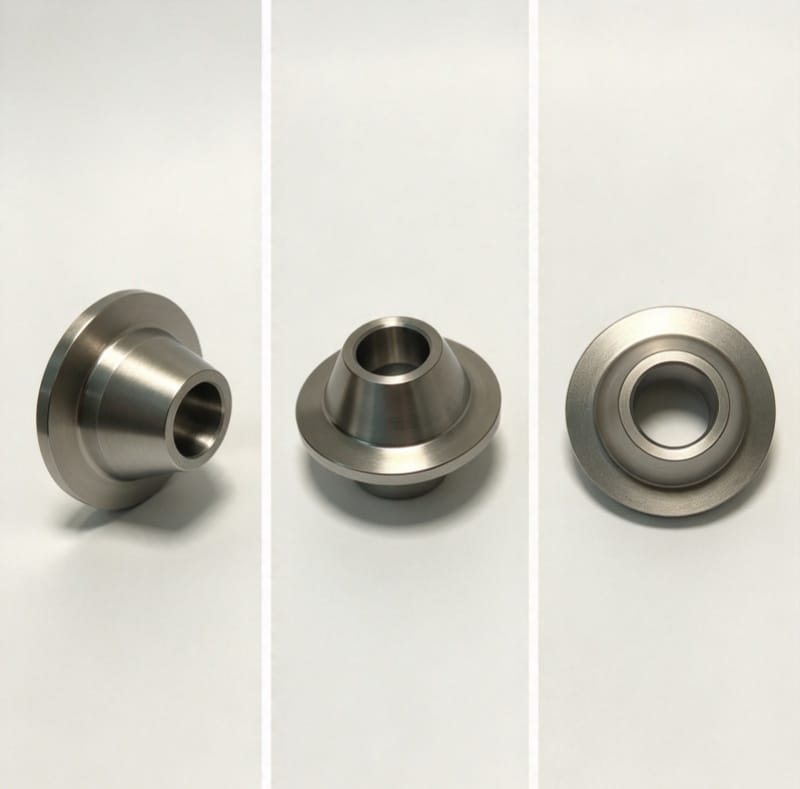
Titanium alloy is a well known “love & hate” material in CNC machining. Grade 5 Ti-6Al-4V (4.43 g/cm³) is just 56% the weight of 304 stainless steel (7.93 g/cm³) for identical parts, cutting mass by 44% while providing excellent seawater and bio-fluid corrosion resistance
However, it creates major manufacturing challenges. Take Ti-6Al-4V raw stock as an example: its thermal conductivity is only 1/5 that of steel. Its low elastic modulus leads to significant springback, while high chemical reactivity at cutting temperatures causes severe tool built up edge (sticking).
Blog Outline
Why Is Titanium Widely Used Despite Its Machining Difficulty?
Titanium is widely used cuz its combination of high strength to weight ratio, superior corrosion resistance, high-temperature stability, bio compatibility and non magnetic behavior can’t be replicated by cheaper, easier to cut metals.
Titanium Grade Selection: Gr2 vs Gr5 (TC4) vs Gr9 / Gr23
Four grades cover nearly all precision machined titanium parts. Engineers frequently encounter multiple naming conventions TC4, Grade 5, Ti-6Al-4V, which refer to the same Titanium . It made you confuse? Let’s make it clear.
The table below compares grades, material standards, key properties, machining difficulty, relative raw material cost and typical use cases for quick reference.
Titanium Grade | Material Standard | Key Properties | Machining Difficulty | Relative Raw Material Cost |
Grade 2 (Commercially Pure Ti) | ASTM B348 | CP titanium with excellent ductility; great resistance to seawater & organic acid; moderate strength | ★★☆☆☆ | 1.0 |
Grade 5 (TC4, Ti-6Al-4V) | ASTM B348 / GB/T 3620.1 | α β titanium alloy, widely known as TC4 in Chinese CNC machining manufacturer. Balanced mechanical performance; good heat resistance & fatigue performance | ★★★★☆ | 1.4~1.6 |
Grade 9 (Ti-3Al-2.5V) | ASTM B348 | Thin wall optimized alloy; superior ductility and weldability; strength close to Grade 5 | ★★★☆☆ | 1.5~1.7 |
Grade 23 (Ti-6Al-4V ELI) | ASTM B348, ASTM F136 | Extra low interstitial variant with tightly controlled oxygen & iron content; high toughness, biocompatible for implant use | ★★★★☆ | 2.0~2.4 |
Note: Relative cost just for raw bar material prices only. They exclude machining labor and tooling expenses. Due to high tool wear and higher scrap risk for Gr5 and Gr23, final finished part price gaps will be larger than raw material differences.
Grade 2 CP Titanium: Prioritize Corrosion Resistance & Ductility
Grade 2 commercially pure titanium contains no strengthening alloying elements. It exhibits limited work hardening during cutting and produces lower cutting forces. It performs well under long term submersion in seawater or weak acid environments. Not recommended for components under sustained high mechanical loads.
Ti-6Al-4V Grade 5 (TC4): Workhorse Alloy for Aerospace & General-Purpose Precision Parts
Grade 5 Ti-6Al-4V ( TC4) is the most widely-specified titanium alloy globally and the default starting point for most projects. It balances strength, heat resistance and machinability. It’s heavily deployed in aerospace, automation fixtures, new energy tooling and lightweight racing assemblies.
Grade 9 & Grade 23: Specialized Choices for Thin Wall Tubing and Medical Implants
Grade 9 is primarily used for tubular thin wall components and delivers better weldability than Grade 5 (TC4). Grade 23 is the implant grade medical variant. It requires strict material traceability and impurity control, so higher budget is necessary.
Process Route Selection of Titanium CNC machining: Precision Turning, Milling & 5-Axis Machining
For precision turning of titanium parts, avoid excessive tool overhang and insufficient system rigidity. When turning thin wall sleeves, adopt a strategy of heavy support, small stock allowance and multiple finishing passes to minimize cumulative deflection errors. Keep spindle speed low and moderate feed rates to reduce heat generation per unit time.
Milling and 5-axis machining are preferred for complex free form geometry, ball nose tools work at an optimized lead angle to produce thinner chips and stable cutting force vectors. This greatly suppresses thin wall deflection and high frequency chatter. Fewer re fixturing operations also deliver better dimensional consistency across batches.
Cutting Parameters & Practical Tooling Guidance
For titanium machining, follow the principle: higher depth of cut, moderate feed per tooth. Don’t forget to select K grade cemented carbide tools with TiAlN coating.
Deformation & Tolerance Control: Is ±0.005 mm Achievable in Titanium?
Tolerances of ±0.005 mm are possible for titanium parts, but only under specific conditions, determined by part size, wall thickness, rigidity and feature location. Real world shop floor baseline standards:
- Standard 3-axis milling for TC4 titanium: ±0.05 mm
- Standard 5-axis milling for TC4 titanium: ±0.03 mm
Cost and scrap rate rise non linearly as tolerances tighten. Specifying ±0.005 mm on non critical surfaces wastes budget on unnecessary inspection and rework.
DFM Design Guidelines of precision Titanium CNC machining
- Minimum wall thickness: Wall thickness below 0.5 mm suffers extreme deformation risk for titanium. Target ≥1.0 mm for stable production.
- Internal radii: Specify internal corner radii R≥0.5 mm. Sharp inside corners damage cutters and create stress concentration points.
- Deep holes / deep slots: When depth to diameter ratio exceeds 4:1, plan multi operation workflows instead of attempting one shot machining.
- Tolerance strategy: Apply tight tolerances only to functional surfaces. Relax tolerances on non critical geometry to balance quality and cost. Due to titanium’s material behaviour, ultra tight global tolerances are impractical.
What’s Key Factors Influencing Quotation & Lead Time during the custom Titanium machined parts?
- Raw material expense (Gr5 / TC4 costs significantly more than Gr2; Gr23 carries the highest material premium).
- Tooling consumption: Short tool life spreads tool replacement cost across total machining hours.
- Total cycle machining time.
Additional expenses come from inspection requirements. Load bearing or medical grade parts requiring material certificates, ultrasonic testing or full dimensional inspection push up unit price and extend lead times.
To receive fast, accurate Titanium parts cnc machining quotations: submit complete drawing packages including material grade, tolerance requirements, surface finish specifications, batch quantity, plus both 2D drawings and 3D models.
Titanium Grade Quick Reference
- Corrosion-resistant, low-load parts: Grade 2 (CP Ti)
- General high-strength lightweight structural components: Grade 5 (TC4)
- Orthopedic implant applications: Grade 23 (TC4 ELI)
- High-temperature engine components: TC11, Ti-6-2-4-2
- Ultra-high-strength aerospace landing gear: TB6, TC18
Have drawing but unsure about manufacturability? Welcome you reference our CNC materials selection page & click our other blog of CNC stainless steel guide, carbon steel grade selection, CNC machined alloy steel material selection, Aluminum CNC materials Selection. Send over your 2D drawings, 3D models and operating requirements. We deliver DFM feedback and transparent quotations based on alloy grade, tolerance constraints and order volume. In house 5-axis machining capability, full process quality inspection, OEM & ODM supported. Free manufacturing feasibility assessment, response within 24 working hours.
FAQs
Q1: Grade 2 vs Grade 5 (TC4), which one should I choose for my part?
Select Grade 5 (TC4 / Ti-6Al-4V) for load-bearing structural applications. Choose Grade 2 for corrosion driven, non load bearing parts to reduce cost. Send us your operating condition requirements and we can give targeted advice quickly.
Q2: Why are TC4 titanium part quotations much higher than stainless steel parts?
Higher raw material price, short cutting tool service life and longer cycle times from reduced cutting speeds combine to increase total cost.
Q3: Can you manufacture OEM custom parts from drawings? Will you alter my design?
Yes, we produce strictly to customer drawings. We will propose DFM optimizations to lower scrap risk and unit cost. Final production always follows your confirmed drawing release.
Q4: Can you supply material certificates and inspection reports for titanium parts?
Yes. Material test reports, full dimensional inspection reports are available. Quality records are archived for all critical production steps.
Q5: What happens in case of first article scrap or quality issues?
Every part is fully inspected before shipment to prevent defective units from being delivered. Acceptance criteria are confirmed upfront against your drawing specifications. We take responsibility for genuine process related defects, offering re manufacturing or refunds warranty.
Q6: What surface treatments are available for titanium components?
Many titanium components ship out as machined condition without functional coating. Passivation is also used for certain operating environments. When extra surface modification is required, common options include: Bead blasting, Titanium anodizing (Type II), Electropolishing, Micro Arc Oxidation (MAO), Pickling / acid cleaning
Q7: What inspection tools/methods do you use for custom titanium parts?
We use CMM coordinate measuring machines, optical comparators, micrometers and surface roughness testers.
Q8: Does titanium rust or corrode?
Titanium forms a self protective passive oxide film when exposed to oxygen. It provides excellent resistance against seawater, most acids and humid environments and won’t rust like carbon steel. Note: Strong reducing media such as hydrofluoric acid will attack titanium.
Q9: What industries use custom CNC machined titanium parts?
Aerospace & aviation, medical implants & surgical instruments, marine engineering, oil & gas, robotics, motorsport racing, vacuum equipment, chemical processing systems and more.
Q10: Titanium vs 304 stainless steel: strength and weight difference? Is titanium stronger than stainless steel 304?
304 stainless steel density is 7.93 g/cm³, significantly heavier than Grade 5 titanium at 4.43 g/cm³. Grade 5 Ti-6Al-4V delivers far higher specific strength. 304 stainless steel has moderate tensile strength, while TC4 Grade 5 offers significantly higher ultimate tensile strength. If lightweight is your priority, titanium is preferred. If weight is not a concern, 304 stainless steel can be a more cost effective alternative.
Q11: Ti-6Al-4V vs 304 stainless steel: which has better corrosion resistance?
Titanium outperforms 304 and even 316L stainless steel in seawater, chloride rich brine & biological fluid environments. 304 stainless steel risks pitting corrosion under high chloride conditions. For general indoor atmospheric corrosion, both materials perform well; 304 stainless steel is more economical for non marine applications.
Share this article