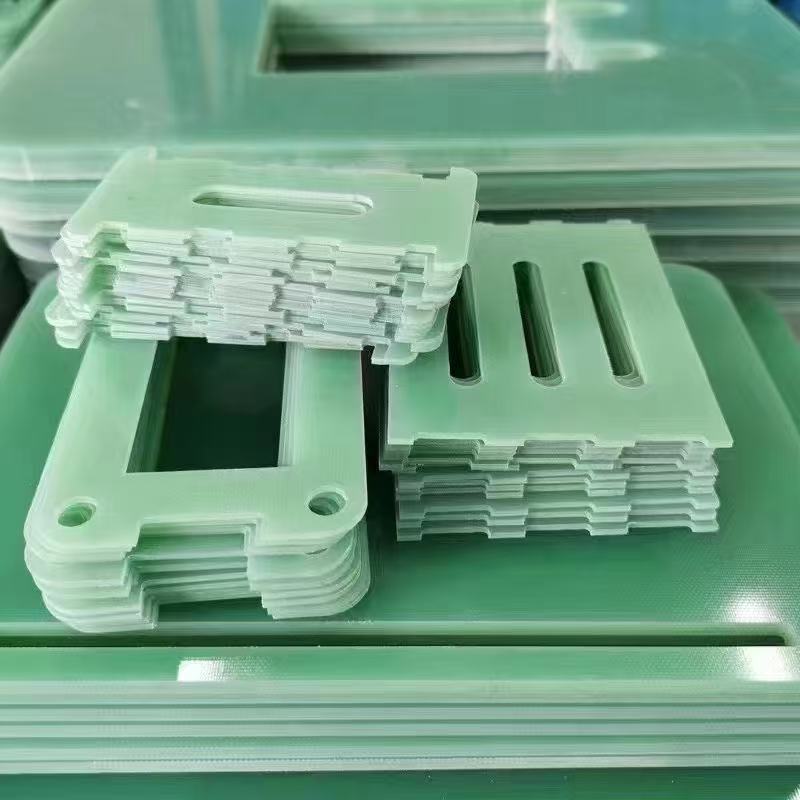
Fiberglass epoxy machined parts are a go-to choice for insulating structural components. We have 15 years of mass production experience in CNC non-metallic machining, this guide breaks down the performance differences between mainstream fiberglass grades (FR4, G10, G11 and more) under the NEMA LI 1 standard. We cover core fiberglass CNC machining challenges, process tradeoff strategies, practical tolerance, and cost control techniques to help you make DFM-aligned material choices, avoid delivery risks, and keep overall costs in check.
Blog of Outline
1. CNC Machined Fiberglass Parts Materials Comparison
Fiberglass epoxy laminates comply with the NEMA LI 1 standard. The core differences between grades lie in resin formulation, temperature resistance and flame retardant performance.
Grade | Heat Deflection Temperature | Dielectric Strength (Perpendicular) | Relative Cost Factor | Recommended Applications | Not Recommended For |
FR4 | 130°C | 20 kV/mm | 1.0 (baseline) | General electronic insulators, equipment support plates, test fixtures, jig bases | Long-term operation above 130°C, low-cost projects with no flame retardant requirement. FR4 works perfectly for most room-temperature scenarios. |
G10 | 130°C | 20 kV/mm | 0.9 | Industrial structural parts with no flame retardant requirement, high/low voltage electrical insulators, mechanical gaskets | Electronic equipment, home appliances, rail transit interiors that require flame retardant certification |
G11 | 180°C | 22 kV/mm | 1.35 | High-temperature equipment insulating structures, oven components, new energy vehicle high-voltage insulators | Room-temperature general applications, scenarios with mandatory flame retardant requirements |
FR5 | 180°C | 22 kV/mm | 1.5 | High-temperature electronic devices, new energy battery pack insulators, industrial power modules | Room-temperature general applications, extremely cost-sensitive projects |
2. Key Fiberglass CNC Machining Service Challenges
The laminated structure and non-metallic nature of fiberglass sheets create machining challenges very different from metals. There are 5 main pain points:
- Interlaminar delamination and edge chipping
- Rapid abrasive tool wear
- Resin softening and tool buildup from cutting heat
- Distortion caused by internal stress release
- Dust evacuation issues and surface scratching
3. CNC Machining Fiberglass Process Trade-offs & Machining Strategies
There’s no one-size-fits-all optimal solution for fiberglass machining. Every parameter choice is a balance between quality, efficiency and cost. Based on mass production experience, here’s the decision logic for core process dimensions:
3.1 Tool Selection: Balance Tool Life vs. Per-Part Cost
- High-speed steel (HSS) only works for small-batch prototype runs.
- Solid ultra-fine grain carbide tools are ideal for small to medium production volumes.
- PCD diamond-coated tools have higher upfront cost, but deliver lower total cost for high-volume orders.
3.2 Cooling Method: Choose Based on Insulation Requirements
Pay special attention to FR4’s water absorption rate. Water-based coolant isn’t allowed for high-insulation parts. We only use water cooling with a post-machining drying process for parts where insulation performance isn’t critical.
3.3 Workholding & Stress Control: Reduce Machining Warpage
- Use vacuum chucks or double-sided adhesive for thin sheets.
- For thick plates, add a stress-relief resting period after roughing, and follow a “inside features first, outside features second” machining sequence.
4. Tolerance Standards for Fiberglass CNC Machining
Fiberglass sheets have different achievable tolerance capabilities than metals. The tolerance recommendations below follow the ASME Y14.5 standard and represent stable, mass-producible levels:
Tolerance Category | Precision Grade | Tolerance Value (Inch / Metric) | Typical Use Case | Notes |
Dimensional tolerance | Standard production (IT10–IT12) | ±0.005 inch / ±0.127 mm | Non-fit dimensions, general structural parts, standard mounting holes | Yield rate above 98%, lowest machining cost. This is our default delivery grade. |
Precision grade (IT7–IT9) | ±0.001 inch / ±0.025 mm | Fit dimensions, precision mounting holes, locating datum features | Requires optimized cutting parameters, brand-new tools and controlled ambient temperature. Machining cost is 50%–100% higher than standard grade. | |
Precision bore (drill + ream process) | ±0.0005 inch / ±0.0127 mm | Precision fit holes, dowel pin holes | Bore tolerances are easier to hold consistently than outer profile dimensions. We recommend a combined drill + reaming process. | |
Geometric tolerance – Flatness | Standard grade | 0.002 inch/inch / 0.002 mm/mm | General mounting datum surfaces, support surfaces for ordinary structural parts | Harder to control on larger parts. Relax tolerances for extra-large components. |
Precision grade | 0.0005 inch/inch / 0.0005 mm/mm | High-precision datum surfaces, sealing fit faces, inspection fixture surfaces | Not recommended for parts larger than 12×12 inch (300×300mm). | |
Geometric tolerance – Parallelism / Perpendicularity | Standard grade | ±0.003 inch / 3 inch (±0.076 mm / 76.2 mm) | General assembly surfaces, standard structural side walls | Achievable with standard milling processes, no extra process cost. |
Precision grade | ±0.001 inch / 3 inch (±0.025 mm / 76.2 mm) | Precision assembly datums, locating mounting surfaces | Requires separate roughing and finishing operations plus stress relief. Slightly longer lead time. | |
Geometric tolerance – Position | Standard grade | ±0.003 inch / ±0.076 mm | General mounting hole patterns, non-critical locating holes | Achievable with standard CNC machining. |
Precision grade | ±0.001 inch / ±0.025 mm | Precision locating hole patterns, fit mounting holes | Requires new tools, optimized tool paths and dedicated drill-ream sequences. |
Tolerance Control Best Practices
- Internal stress release: After machining thick or large-area parts, internal stress continues to release. Dimensional change can exceed 0.002 inch (0.05mm) within 24 hours. For precision parts, we recommend a 24-hour temperature-stabilized resting period before final inspection.
- Temperature and humidity effects: Fiberglass sheets expand slightly with ambient humidity changes. Parts requiring tolerances tighter than ±0.001 inch (±0.025mm) must be machined and inspected in a constant temperature and humidity workshop.
- Smart dimensioning: Only apply precision tolerances to critical fit dimensions. Use general tolerances for non-critical features,unnecessary high-precision requirements will drastically increase cost.
5. Surface Finishing Options for Precision Fiberglass Machining
Surface Finish Option | Roughness (Ra) | Core Characteristics | Typical Applications | Relative Cost Factor (vs. as-machined baseline) |
As-machined milled surface | 1.6~3.2 μm / 63~125 μin | Default CNC delivery state, with light tool marks and basic edge deburring. Fewest operations, lowest cost. | General insulating structural parts, internal equipment mounts, non-visible functional parts | 1.0 (baseline) |
Precision grinding & polishing | 0.4~0.8 μm / 16~32 μin | Removes tool marks via surface grinding/polishing, significantly improves flatness and surface finish. | Sealing fit faces, optical instrument bases, exposed cosmetic parts, high-precision datum surfaces | 1.3 ~ 1.5 |
Chamfering & deburring | Does not change base surface roughness | Applies C0.2~C1.0 edge breaks to remove fiberglass chipping and burrs, eliminates assembly scratch risks. | All machined parts (highly recommended as standard) | ≈ 1.05 (very low cost increase) |
Silk-screening & marking | Does not change base surface roughness | Prints scales, part numbers and symbols with dedicated epoxy ink. Strong adhesion, heat and abrasion resistant. | Equipment panels, parameter identification parts, installation alignment markers | 1.1 ~ 1.2 |
Surface metallization (electroless Cu / Ni plating / aluminum spray) | Forms a continuous metal layer on surface | Adds electrical conductivity and electromagnetic shielding. Requires surface roughening first for coating adhesion. | EMI shielding parts, grounding connectors, signal conducting structures | 1.5 ~ 3.0 |
6. CNC Milling Fiberglass Cost Factors & Practical Selection Tips
6.1 Custom Fiberglass Machined Parts Cost Factors
The cost of fiberglass machined parts can vary by several times. Decisions made during material selection and design have a far bigger impact on final cost than the machining stage itself.
Material grade: Using FR4 as the cost baseline of 1, G10 costs roughly 0.85–0.9x, G11 costs 1.3–1.4x, FR5 costs 1.4–1.6x. Custom specialty grades cost even more.
Sheet thickness: Standard thicknesses (0.04 inch/1mm, 0.06 inch/1.5mm, 0.08 inch/2mm, 0.12 inch/3mm, 0.2 inch/5mm, 0.4 inch/10mm) have ample stock and the lowest prices. Ultra-thin (<0.02 inch/0.5mm) or ultra-thick (>1.2 inch/30mm) sheets cost 50%–200% more and have longer lead times.
Tolerance grade: Precision tolerance machining costs 1.5–2x more than standard grade, due to extra inspection steps and lower machining efficiency.
Surface treatment: Special finishes like polishing or metallization increase part cost by 30%–200%.
Order volume: Per-unit cost for 1–10 piece prototypes is 3–5 times higher than 1000+ piece batches, due to programming, setup and material waste overhead. Unit cost flattens out above 500 pieces.
6.2 Where to use FR4, G10 and G11
- Room-temperature electronic insulation, general structural parts with flame retardant requirement: Choose FR4 first. It has the strongest versatility, the most mature supply chain, and the best value. It’s the optimal solution for 90% of applications.
- No flame retardant requirement, lowest material cost priority: Choose G10. It has better mechanical properties than FR4 at slightly lower material cost, ideal for internal structural parts of industrial equipment.
- Long-term operation above 120°C, no flame retardant requirement: Choose G11. It has excellent high-temperature dimensional stability and prevents deformation failure at elevated temperatures.
- High-temperature electronic applications with flame retardant requirement: Choose FR5. It combines heat resistance and flame retardancy, and is the mainstream choice for new energy and industrial power applications.
6.3 Where to avoid Fiberglass Sheets CNC Machined Parts
- Parts subject to repeated impact or dynamic loads: Fiberglass has low interlaminar shear strength, and long-term impact can cause delamination and fracture.
- Direct food or medical contact applications: Epoxy resin may leach harmful substances and doesn’t meet food/medical grade standards.
- High-speed sliding fit components: Fiberglass has unstable friction coefficients, and wear-generated dust accelerates component wear.
6.4 Design Cost Reduction Tips
- Prioritize standard thickness sheets over custom thicknesses. This saves over 30% on material cost and lead time.
- Optimize part nesting to improve sheet utilization and reduce scrap. We recommend a minimum 70% utilization rate for standard parts.
- Only apply high-precision tolerances to critical dimensions. Use default general tolerances for non-critical features to avoid over-machining.
- Combine small-batch orders into a single production run to amortize setup and programming costs. This can reduce per-unit cost by 20%–30%.
7. Conclusion
Fiberglass epoxy sheets CNC machining are extremely cost-effective insulating structural materials. The key to successful selection and machining lies in matching material performance to operating conditions and making reasonable tradeoffs.
In the selection stage, don’t blindly chase higher performance grades, choose the grade that matches your operating temperature and flame retardant requirements. In the machining stage, optimize tooling, parameters and workholding for the laminated structure characteristics to balance quality and efficiency. For tolerance specification, align requirements with actual fiberglass machining capability to avoid unnecessary cost waste.
If you have custom fiberglass CNC machining needs, we also offer custom machining for aluminum, stainless steel, carbon steel, titanium, copper and engineering plastics. Whether you need prototyping or mass production, contact our engineering team for free DFM analysis, process optimization advice and an accurate quote. Welcome you reference our CNC materials selection page & click our other blog of CNC stainless steel guide, carbon steel grade selection, CNC machined alloy steel material selection, Invar low expansion alloy, Inconel CNC machining, Aluminum CNC materials Selection.
8. FAQ
1. What’s the core difference between FR4 and G10 fiberglassduring CNC machining?
The main difference is flame retardancy: FR4 meets UL94 V-0 flame retardant standards, while G10 has no flame retardant rating. Their mechanical and insulating properties are similar. FR4 has wider general use and a more mature supply chain.
2. What’s the tightest tolerance achievable with CNC machined fiberglass?
Per ASME standards, precision machining can consistently hold ±0.001 inch (±0.025 mm) dimensional tolerance, and ±0.0005 inch for reamed bores. Tolerances for large-area parts should be relaxed due to internal stress effects.
3. What tool offers the best value for fiberglass machining?
For small to medium batches, solid ultra-fine grain carbide tools are recommended — they’re versatile and moderately priced. For high-volume production, PCD diamond-coated tools are preferred. They last 10–20 times longer than carbide and deliver lower total cost.
4. What high temperature can G11 fiberglass machined parts withstand long-term?
G11 has a heat deflection temperature of around 180°C, and can operate stably long-term at 150°C. Long-term operating temperature for FR4 and G10 shouldn’t exceed 120°C.
5. Why does fiberglass machining often cause chipping and delamination?
Fiberglass has a glass cloth laminated structure with low interlaminar shear strength. Dull cutting edges or excessive axial cutting force can tear the interlaminar resin, causing chipping and delamination at hole edges and part perimeters.
6. Can you use water-based coolant for fiberglass CNC machining?
Water cooling can be used for roughing to improve efficiency and tool life, but it isn’t recommended for cutsom high-precision insulating parts. Water cooling causes the sheet to absorb moisture and swell, affecting dimensional accuracy and insulation performance. Low-temperature drying is required after machining if water coolant is used.
7. Are fiberglass board and epoxy board the same material for CNC machining?
They’re often used interchangeably in casual conversation. Strictly speaking, fiberglass board is glass fiber cloth reinforced epoxy laminate, which is one type of epoxy board. Epoxy board also includes paper-based, cotton-based and other substrate types.
8. What are the best ways to reduce cost for batch fiberglass machining?
Prioritize standard-thickness FR4 sheets, relax tolerances on non-critical dimensions, optimize nesting to improve material utilization, and combine orders to amortize setup costs. These steps can reduce per-unit cost by over 30%.
Share this article